
By Marcus R. and Staff
The college application process feels less stressful when you start early. Stay organized, and take advantage of tools like the Common App. Also, make a plan, talk to your guidance counselor, and give yourself plenty of time.
What is the Common App?
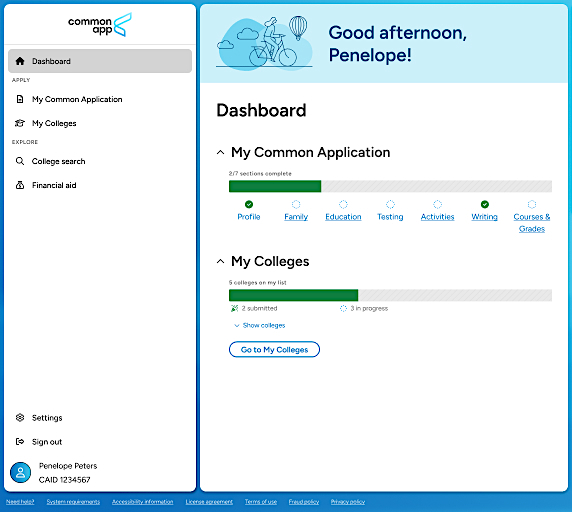
Think of the Common App as a tool to organize information. The Common App, which is completely free to use, will ask you a multitude of questions, collect this information, and then use this information to apply directly to schools on your behalf. Essentially it’s a big application for many schools (hence the name Common App). It allows you to quickly track applications, essays, recommendations, and enrollment deadlines all in a single place. Most state schools accept the Common Application, for instance (like UF, UCF, USF, UNF, Santa Fe, and Valencia).
Step 1: Create Your Account
Now, to get started with Common App, go to their website, commonapp.org and set up your account. When you set up your account it is important to remember not to use an academic or school email address, as you will still need access to this account after you graduate.
Additional Tips
– Start as early as the end of 11th grade so you’re not scrambling senior year.
– Pro tip: check in with your guidance counselor about the possibility of fee waivers for the Common App, SAT, or ACT. They’re there to help you out.
– Get a copy of your high school transcript. It will help when you self-report your grades into the Common App.
Step 2: Fill Out Your Profile
Next, it will be necessary to fill out your Common App profile. This is usually the longest part. Anticipate spending at least 3 hours on the application. You’ll be asked for:
– Your comprehensive academic history and test scores.
– Clubs, sports, volunteering, and leadership roles.
– Jobs, internships, or other work experience.
– Writing samples (essays or statements of purpose).
Additional Tips
– If you can, take both the SAT and ACT at least once. Some schools prefer one over the other.
– Start early. If you chip away at it little by little, it won’t feel so overwhelming.
– Work on applications with a friend. Sometimes two heads are better than one.
Step 3: Add Colleges to Your List
Next, use the College Search tool to find schools you would like to apply to. It’s important to add a variety of schools to your application list. Between dream schools, target schools, and safety schools, it’s best to have a mix of all three to ensure that you can achieve your goal of going to college. During this step it is important to look at all of the factors that make each school unique, such as location, size, public or private, and whether the SAT or ACT scores are required.
Additional Tips
– Don’t feel pressured to only apply to “big name” schools. Find schools that fit your needs and goals.
– Look for local and minority scholarships. A quick search for “scholarships in [your area]” can lead to great opportunities.
Step 4: Answer School-Specific Questions & Essays
After selecting the schools you would like to apply to, it is important to customize your general Common App profile to each school.
Almost every college and university has its own section in the Common App where they may ask short questions or essays. Expect a minimum of about 10 to 20 minutes per school.
And… if the essay is optional, don’t skip it! This is your chance to show the school who you really are. Start drafts early and ask a teacher or counselor for feedback.
This section of the application will likely ask for information related to your major and school. It’s important to remember that you need to be specific about your application (i.e. don’t copy-paste the same generic answers between schools). Also be sure to avoid the use of generative AI or LLM tools when filling out these sections. It needs to be in your own words.
Step 5: Add Letters of Recommendation/Recommenders
Depending on which schools you apply to, letters of rec may or may not be required. If they are, it’s important to remember what they are looking for. Colleges want to hear about you from people who know you well.
In a kind and straightforward manner, ask teachers, counselors, coaches, or mentors who can speak about your strengths. DO NOT ask every teacher you’ve had. Choose the ones who know you best.
Additional Tips
– At least one letter of recommendation is good, but two is often even better.
– Ask early and give them plenty of time. Share your goals with them so they can write a strong, personal letter for you.
Step 6: FAFSA & Financial Aid
Now that your application is mostly finished, another important step is to fill out the FAFSA (Free Application for Federal Student Aid) at studentaid.gov. The FAFSA typically opens on October 1 (sometimes later, check website updates). This application is required for federal grants, loans, and many scholarships. Some aid is first-come, first-served, so submit it as soon as you can.
Step 7: Deadlines to Know
Deadlines can sneak up fast, so keep track of them. If applying to college at the beginning of your senior year some general deadlines are as follows:
-FAFSA Opens: October 1st
– Early Action: around November 1st
– Early Decision: November 1st or 15th (this is more common for exclusive schools and universities)
– Regular Decision: January 1st or later (depending on the school)
Additional Tips
– Create a calendar or checklist to stay on top of everything.
– Worrying that you may have missed an application deadline? Keep in mind that some schools offer rolling admissions and therefore do not have strict application deadlines.
Step 8: Submitting & Celebrating
Once you’ve triple-checked your application, essays, recommendations, and deadlines, it’s time to hit submit!
– Try to submit a few days before the deadline just in case of issues with submitting your application.
– Take a screenshot or save confirmation emails so you have proof of submission.
– Then celebrate. You’ve officially applied to college!
Final Thoughts & Miscellaneous Tips
– Some schools may ask for additional forms. Read carefully.
– Keep checking your email for important updates after you submit.
Relevant Article Links
Common App: https://www.commonapp.org/
FASFA: https://studentaid.gov